
AI that knows the regs
better than your best adjuster.
Every claim checked against the actual regulation, with citations, before errors become audit findings.
Compliance-heavy lines run on manual review
- Regulation sprawlFCIC, LAM, PPSH, state-by-state rules. Thousands of paragraphs a reviewer is expected to hold in their head.
- Line-by-line reviewDocs on one screen, claim data on the other. Errors get caught manually, or they don't.
- Hidden until the auditBelow-threshold claims get no review at all. Issues stay invisible until they become audit findings.
- Peak-season backlogVolume compresses review time. The backlog grows. Payments lag.
Follow one claim through Veltha
A workers' comp compensability file, from intake to a cited decision. The same engine runs crop.
- ISO ClaimSearch2 matches
- EDEX (WCAB)1 prior application
- CMS Section 111 queryNot Medicare entitled
- R5Current MRI, 2026On file
- R6Prior treatment & imaging, 2021–2023Missing
- AME / Panel QME (med-legal)Not requested
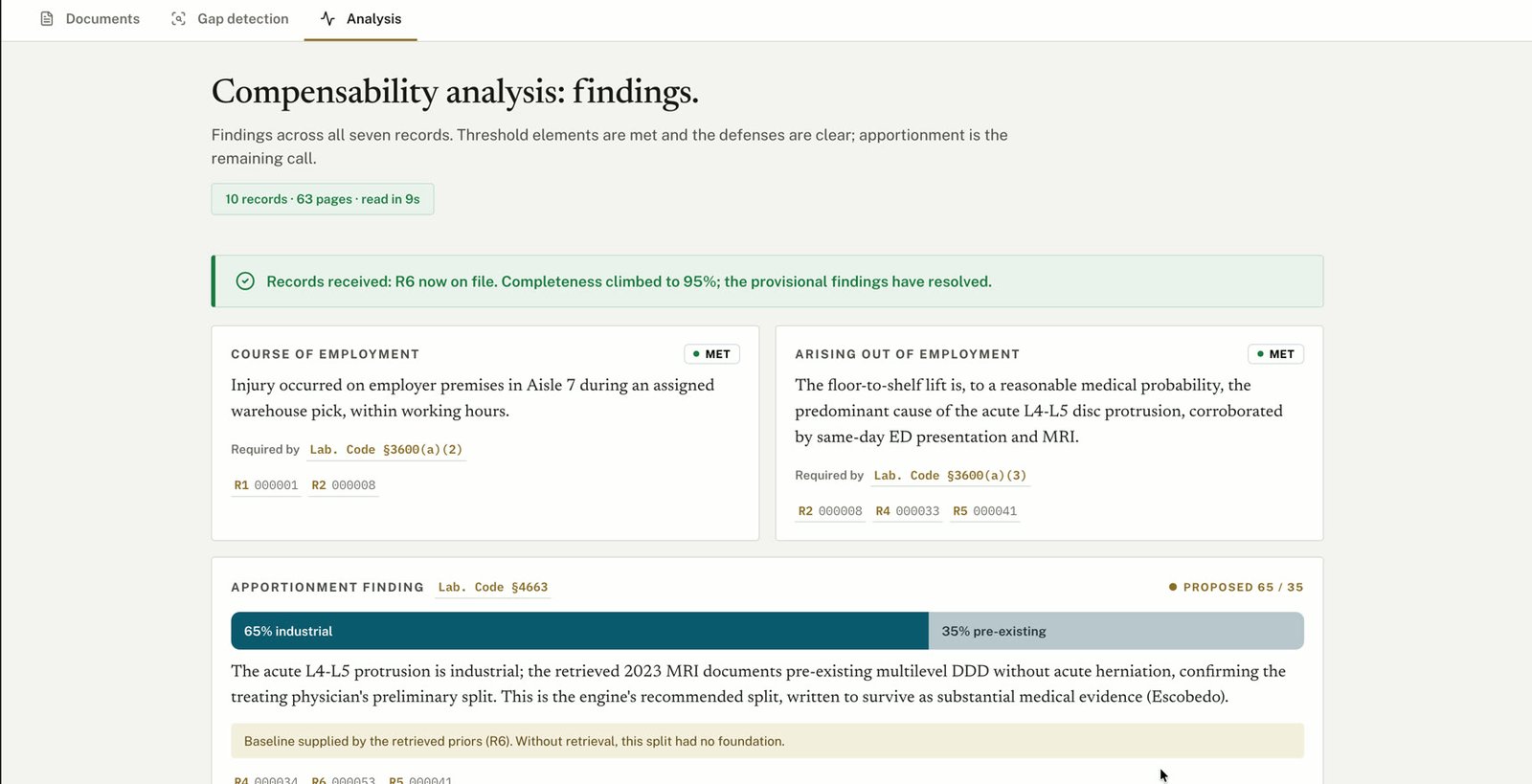
- Course of employmentLab. Code §3600(a)(2)● MET
- Arising out of employmentLab. Code §3600(a)(3)● MET
Course of employment ● MET · Arising out of employment ● MET
A claim file arrives.
Employer's report, recorded statements, ED records, wage statements. Typed, scanned, or handwritten, Veltha reads all of it, builds one structured file, and runs the index sweep: ISO, EDEX, and CMS checked before the first adjuster touch.
Every record indexed to the page: 10 records · 63 pages · read in 9s
The file is never complete. Veltha knows what's missing.
Every expected record is mapped against the file. A prior 2023 lumbar claim surfaces from the index sweep; the records that would change the outcome are flagged with a one-click request.
Completeness scored by decision impact: File completeness 62%
Every element, checked against the statute.
Course of employment. Arising out of employment. Each element marked met or not, with the statute it rests on and the records cited down to the Bates number.
Not “anomaly detected,” but Required by Lab. Code §3600(a)(2)
A defensible decision, cited to the file.
An accept or deny recommendation with a proposed apportionment split, written to survive as substantial medical evidence. Your reviewer approves or overrides with full context.
Review time on live claims: 1h → 5min
Lines we cover
Crop Insurance Claims
MPCI, crop-hail, named peril, prevented planting. Checked against FCIC, LAM, and PPSH with paragraph-level citations.
Explore →Workers' Comp Compensability
Records retrieved from every provider, causation analyzed, and a defensible accept/deny recommendation cited to the file. Compensability decisions in days, not months.
Explore →Live in weeks, not quarters
Encode
Upload your documents, handbooks, and regulations. We encode the checks for your line and your states.
Shadow
Veltha runs alongside your reviewers on live claims. You compare its findings against yours, claim by claim.
Production
Every claim checked, every flag cited. Your reviewers keep the final call.
Built by engineers who've encoded regulation into software before
Ex-Palantir engineers who built systems that turn complex regulation into executable AI rules for government and enterprise. Now transforming how workers' comp decisions get made.


See Veltha handle a real claim from your line
Your documents, your regulations, your workflow. 15 minutes, no commitment.